Build a preparation plan
Map the likely rounds for your role, seniority, and target company.
Open ExploreLearn what to do, what evidence to produce, how it is evaluated, and which mistake to remove before the real interview.
Start with a plan, a specific interview round, or a task you can practice now.
Map the likely rounds for your role, seniority, and target company.
Open ExploreJump to the sequence, evidence, evaluation, and mistakes for that interview.
Choose a roundBrowse the active bank by stage, role, seniority, format, and topic.
Browse tasksTimings vary by company. The work sequence and evaluated evidence are more stable than the exact agenda.
Watch or listen to the prompt, then answer aloud under a time limit with live transcription.
20-45 minVoice
A recording, transcript, answer structure, and attempt history.
Clarity, relevance, correctness, ownership, concrete evidence, and seniority-appropriate depth.
Implement a solution in a code editor, run examples and checks, inspect failures, and submit the final code.
45-90 minCode
Source code, test results, runtime output, complexity reasoning, and the submitted revision.
Correctness, edge cases, complexity, code quality, debugging process, and adherence to the task contract.
Inspect the schema and sample data, write a query with schema autocomplete, run it, and review the result table or database error.
30-60 minSQL
The executable SQL query, returned rows, database diagnostics, and query feedback.
Correctness, output shape, null and duplicate handling, joins and aggregation, and query-plan efficiency.
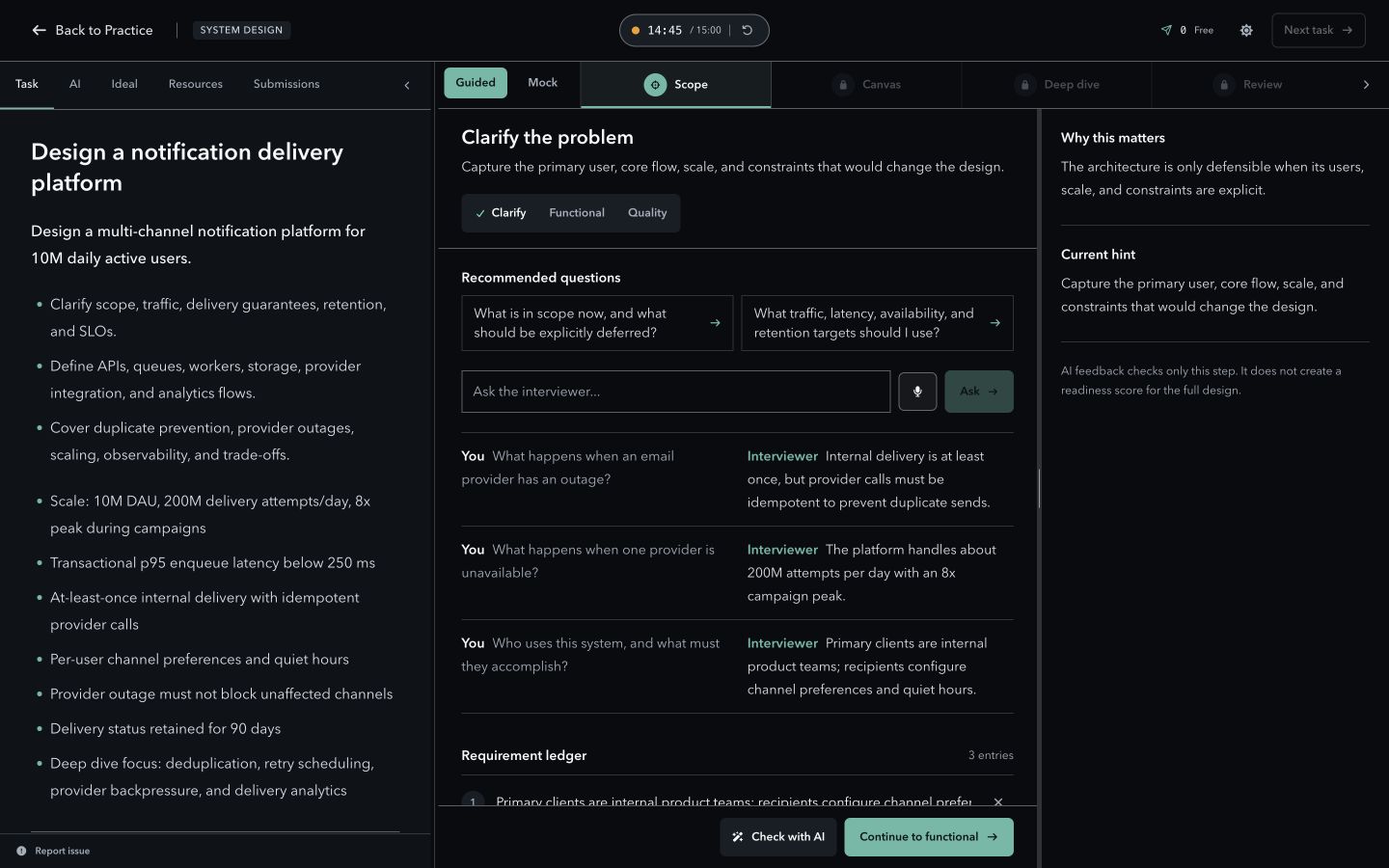
Clarify the problem, define requirements, model components or contracts, draw the architecture, and explain trade-offs.
45-60 minDiagram
Clarifying questions, written decisions, diagrams, contracts, failure paths, and the final walkthrough.
Scope, capacity reasoning, ownership boundaries, data flow, reliability, trade-offs, and implementation depth.
Build evidence-backed notes, answer aloud, handle follow-up probes, and compare attempts.
30-60 minVoice
Story notes, recording, transcript, follow-up answers, and signal-level feedback.
Situation clarity, individual ownership, decisions, measurable impact, reflection, and leadership judgment.
Inspect code, diffs, tests, logs, metrics, or infrastructure evidence; identify the cause; then propose and verify the smallest safe change.
45-75 minInvestigation
Inline review comments, hypotheses, commands, patches, verification output, risks, and rollback steps.
Evidence quality, root-cause reasoning, blast-radius control, fix safety, regression protection, and operational judgment.
Work in a domain-specific notebook, experiment console, model incident, CI/CD, Kubernetes, observability, or infrastructure review workspace.
45-90 minSpecialist lab
Queries, code, metrics, model or system decisions, incident actions, and a final recommendation.
Domain correctness, experimental or operational rigor, production constraints, risk management, and measurable validation.
Each task defines its criteria and seniority expectations. Junior, Middle, and Senior answers can use the same prompt while depth, ownership, trade-offs, and pass thresholds change.
Role, specialization, company environment, topic coverage, previous attempts, and stage readiness shape the next recommendation. Explore and Practice use the same active task bank.
Browse tasks by interview stage and open the workspace that matches the evidence you need to train.