AceStack AI

See every interview stage

Learn what happens, what to do, and what a strong answer must show
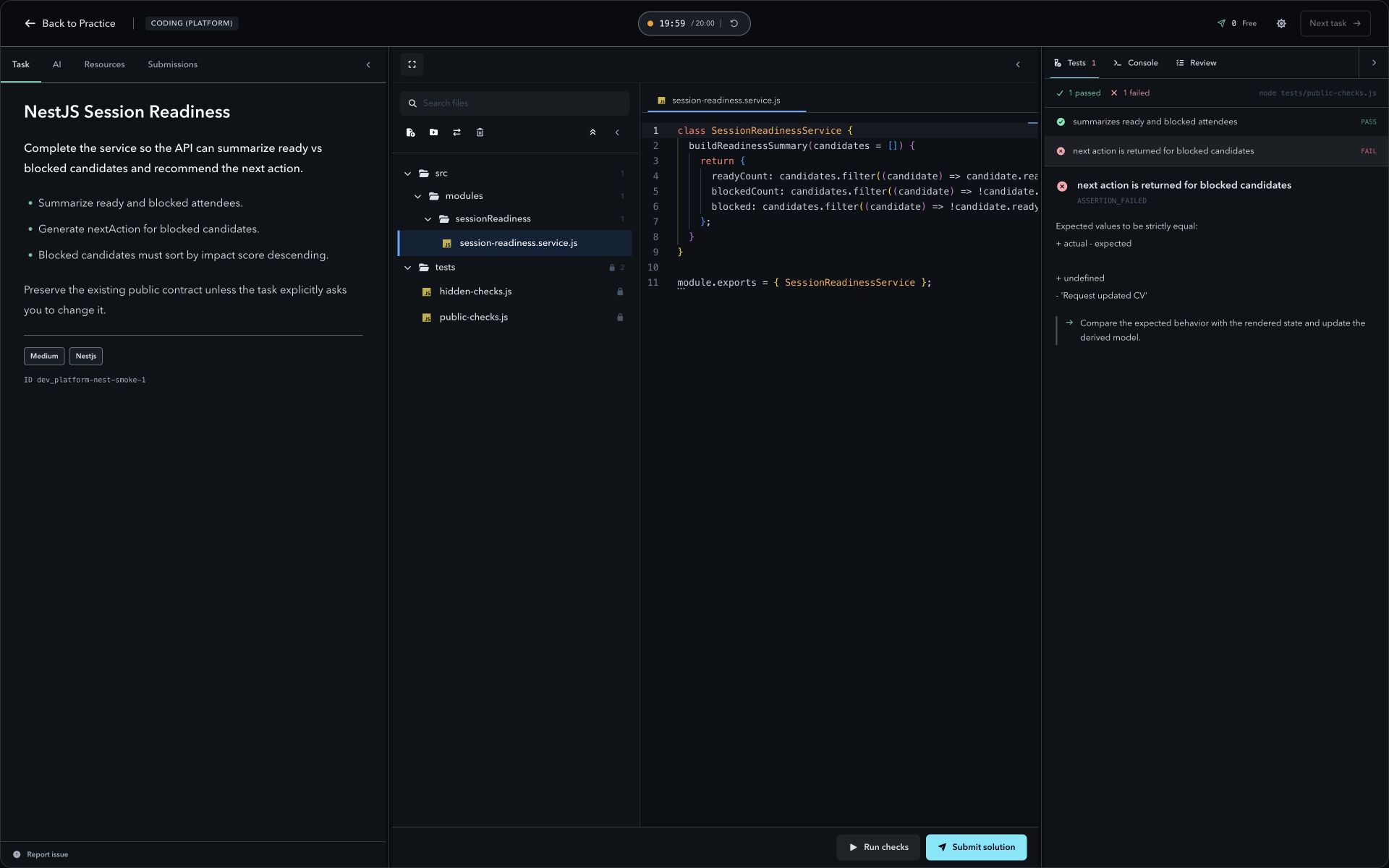
AceStack AI Platform coding workspace with a real task, project files, code editor, checks, and review

Choose where to begin

Build a plan, choose a stage, or open a task

Build a preparation plan

Get the right stages for your role and level.

Open Explore

Study a specific round

See what happens and what a strong answer must show.

Choose a round

Start with a task

Find a task by stage, role, level, or topic.

Browse tasks

How scoring works

Every score starts with your work

We do not score confidence or task count. We review what you submit, use the rules for that round, and compare it with the level you want.

  1. 01

    Check the result

    We use your answer, code, tests, query output, or task choices.

  2. 02

    Apply the task rubric

    Each round has its own clear skills and passing rules.

  3. 03

    Match your level

    Junior, Middle, and Senior answers are judged by different bars.

  4. 04

    Pick the next task

    Readiness changes from reviewed work and points to the weakest stage.

Focus and future paid plans

Three AI models, one clear job each

Free includes speech and final review. Focus adds a separate Coach model for help while you work.

Speech model

Turns a recorded answer into text for review. The audio is not stored after processing.

Review model

Checks your evidence against the task rubric and your target level.

Coach model

Gives focused help inside the task without replacing the final review.

What happens in each stage

The order and timing change by company. The core skills stay the same.

HR and technical screening

Watch or listen to the question, then answer aloud before time runs out.

20-45 minVoice

Before you start

  • Write the target role and the signal this question is likely testing.
  • Choose one recent example with your decision, action, and result.

Run the round

  1. 1Answer the question directly in the first sentence.
  2. 2Support the answer with one concrete example or technical scenario.
  3. 3Handle a focused follow-up without contradicting the original answer.
  4. 4Close by connecting the evidence back to the target role.

What you submit

Your answer, its text, and your past attempts.

What we review

A clear answer, real examples, correct details, and the right depth for your level.

Algorithms and platform coding

Implement a solution in a code editor, run examples and checks, inspect failures, and submit the final code.

45-90 minCode

Before you start

  • Confirm the language, runtime, allowed libraries, and expected input and output.
  • Reserve time for tests, a final walkthrough, and complexity discussion.

Run the round

  1. 1Restate the contract and identify ambiguous inputs.
  2. 2Choose an approach, implement it, and keep the code runnable.
  3. 3Use test failures as evidence, then explain complexity and trade-offs.
  4. 4Review names, edge cases, and the final output before submitting.

What you submit

Source code, test results, runtime output, complexity reasoning, and the submitted revision.

What we review

Correctness, edge cases, speed, code quality, debugging, and following the task rules.

SQL interviews

Inspect the schema and sample data, write a query with schema autocomplete, run it, and review the result table or database error.

30-60 minSQL

Before you start

  • State the output grain before writing a join.
  • Mark fields that can be empty, one-to-one or one-to-many links, and the expected columns.

Run the round

  1. 1Translate the requested output into grain, columns, and filters.
  2. 2Inspect keys and relationships before choosing joins.
  3. 3Run the query, check edge cases, and explain the parts that may be slow.
  4. 4Compare the result shape to the request and remove accidental duplicates.

What you submit

The executable SQL query, returned rows, database diagnostics, and query feedback.

What we review

Correct results, the right columns, safe handling of empty and duplicate data, joins, totals, and query speed.

System and low-level design

Clarify the problem, define requirements, model components or contracts, draw the architecture, and explain trade-offs.

45-60 minDiagram

Before you start

  • Prepare a short checklist for users, scale, latency, consistency, privacy, and availability.
  • Decide which flow and trade-off you will trace in depth if time becomes limited.

Run the round

  1. 1Clarify users, scale, constraints, and what is out of scope.
  2. 2Define requirements and estimates before drawing components.
  3. 3Trace critical flows, failure paths, and one deep technical trade-off.
  4. 4Review the design against the original requirements and state remaining risks.

What you submit

Clarifying questions, written decisions, diagrams, contracts, failure paths, and the final walkthrough.

What we review

Scope, capacity reasoning, ownership boundaries, data flow, reliability, trade-offs, and implementation depth.

Behavioral and leadership

Build evidence-backed notes, answer aloud, handle follow-up probes, and compare attempts.

30-60 minVoice

Before you start

  • Choose a story with a real decision, tension, and consequence.
  • List the facts that prove your own contribution and the result.

Run the round

  1. 1Choose a real story that contains a decision, tension, and outcome.
  2. 2Use short notes while answering aloud; do not memorize a script.
  3. 3Answer follow-ups with evidence and close with what changed afterward.
  4. 4Review the transcript for team-only language and unsupported claims.

What you submit

Story notes, recording, transcript, follow-up answers, and signal-level feedback.

What we review

Situation clarity, individual ownership, decisions, measurable impact, reflection, and leadership judgment.

Code review, debugging, and incidents

Inspect code, diffs, tests, logs, metrics, or infrastructure evidence; identify the cause; then propose and verify the smallest safe change.

45-75 minInvestigation

Before you start

  • Write the observed failure separately from your first hypothesis.
  • Define what evidence would confirm or reject that hypothesis.

Run the round

  1. 1Establish the observed failure and separate facts from hypotheses.
  2. 2Narrow the cause using code, logs, tests, or metrics.
  3. 3Apply the smallest safe change and prove both recovery and non-regression.
  4. 4State the remaining risk, monitoring signal, and rollback trigger.

What you submit

Inline review comments, hypotheses, commands, patches, verification output, risks, and rollback steps.

What we review

Use of evidence, finding the real cause, limiting impact, a safe fix, tests, and sound judgment.

Project deep dive and technical strategy

Build a traceable evidence board, defend personal decisions, respond to pressure, and revise the recommendation when the decision boundary changes.

45-60 minEvidence board

Before you start

  • Choose a project or strategy where your personal decision changed the outcome.
  • Bring a starting point, one option you rejected, one warning sign, and a concrete result.

Run the round

  1. 1Frame the stakes, constraints, scope, and your personal decision rights.
  2. 2Compare credible alternatives and commit to a defensible decision.
  3. 3Connect execution to owners, rollout, measures, and reversible risk controls.
  4. 4Answer the pressure prompt, revise when evidence demands it, and state the transferable lesson.

What you submit

Ownership facts, alternatives, measurable outcomes, migration plan, risk owners, decision metrics, and the pressure response.

What we review

Scope, ownership, technical depth, decisions, team impact, measurable results, and what you learned.

Machine learning and infrastructure

Write executable ML code, defend an owned project, and work in a domain-specific notebook, experiment, system-design, or incident workspace.

45-90 minSpecialist lab

Before you start

  • Identify the baseline, target metric, operating constraints, and failure cost.
  • Choose the domain tool that can produce the evidence needed for a decision.

Run the round

  1. 1Read the complete operational or experimental context before deciding.
  2. 2Investigate through the domain tool: notebook, dashboard, terminal, pipeline, or plan.
  3. 3Commit to a recommendation with validation, risk, and rollback criteria.
  4. 4State what you would monitor after the decision and when you would reverse it.

What you submit

Queries, code, metrics, model or system decisions, incident actions, and a final recommendation.

What we review

Correct domain work, careful testing or operations, production limits, risk control, and measured results.

A workspace for every interview stage

Software interviews

  • HR screeningAvailable
  • Technical screeningAvailable
  • Knowledge checkAvailable
  • Problem SolvingComing soon
  • BehavioralAvailable
  • Algorithm codingAvailable
  • Platform codingAvailable
  • DebuggingComing soon
  • Low-Level DesignComing soon
  • SQL caseAvailable
  • System DesignComing soon

ML and data interviews

  • ML Notebook LabComing soon
  • Experiment ReviewComing soon
  • ML System DesignComing soon
  • Model Incident SimulatorComing soon

DevOps and SRE interviews

  • Incident ConsoleComing soon
  • CI/CD DebuggerComing soon
  • Kubernetes LabComing soon
  • Infrastructure ReviewComing soon
  • Observability CaseComing soon
  • Incident CommandComing soon

Know why you got the score

Every review shows what was strong, what was missing, and what your target level expects.

Practice the right weak point

Your role, level, and past attempts decide which task is most useful next.

Try a real interview task

Choose a stage and practice in the workspace built for it.

Browse tasks