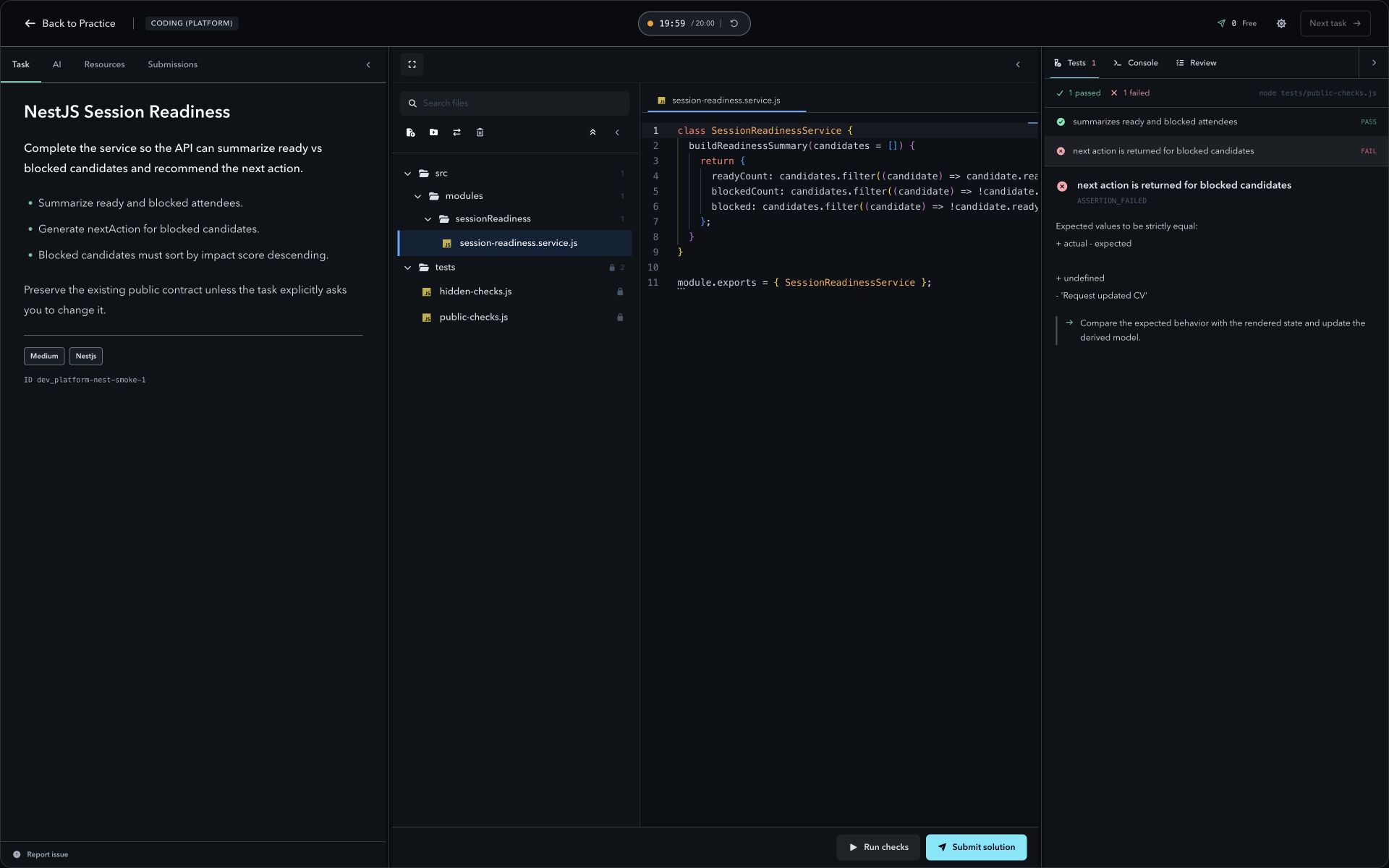
Separate algorithmic coding from platform coding
Algorithmic interviews emphasize decomposition, invariants, complexity, and edge cases. Platform coding tasks look more like a small repository: multiple files, an existing contract, tests, logs, and constraints on what may change. They overlap, but they do not measure exactly the same work.
Preparing only in a single-file editor leaves a gap. Realistic platform tasks require navigation, reading before editing, understanding ownership, and preserving behavior outside the visible happy path.
Strong candidates create a contract before they code
- Restate the input, output, and invalid-input behavior.
- Work through one ordinary case and one boundary case.
- Name the invariant or state transition the solution relies on.
- Choose the implementation only after the complexity target is clear.
This does not require a long speech. Thirty focused seconds can prevent ten minutes of implementing the wrong contract.
Examples are not a test strategy
Sample cases confirm that the interface is understood. They rarely prove correctness. Add cases that attack the chosen approach: empty input, duplicated values, maximum size, invalid state transitions, race conditions, partial failures, or repeated retries.
test('retries do not duplicate the side effect', async () => {
  await deliverWithRetry(message);
  expect(provider.send).toHaveBeenCalledTimes(1);
});Narrate decisions, not keystrokes
“Now I create a map” gives the interviewer no evidence. “I need constant-time lookup of the previous prefix, so I will store the earliest index for each sum” exposes the reasoning and gives the interviewer a useful point to challenge.
When you change direction, say why. Correction is not failure. Silent thrashing is harder to evaluate than a clear statement that an assumption was wrong and the invariant must change.
Platform tasks reward controlled change
- Inspect the entry point, contract, and relevant tests.
- Reproduce the failure before editing.
- Localize the cause and state what evidence supports it.
- Make the smallest change that restores the contract.
- Run focused tests, then the broader suite.
- Explain residual risks and any follow-up work.
The best solution is not always the shortest patch. It is the smallest change whose behavior you can defend.
What changes at senior level
- You expose ambiguity early instead of coding around it.
- You choose an appropriate design, not the most elaborate one.
- You connect tests to production failure modes.
- You preserve observability and debuggability.
- You communicate trade-offs without losing implementation momentum.
These signals should be scored explicitly. A vague impression of confidence is not a reliable evaluation standard.
A practice loop that improves transfer
- Solve once with guidance and record the missed decision.
- Re-solve a related task without guidance within the interview timebox.
- Compare code, tests, and explanation against the rubric.
- Repeat the weak behavior on a different topic until it appears unprompted.
Topic variety matters. If every task is a prefix-sum variant, improvement may be pattern recognition rather than better problem solving.