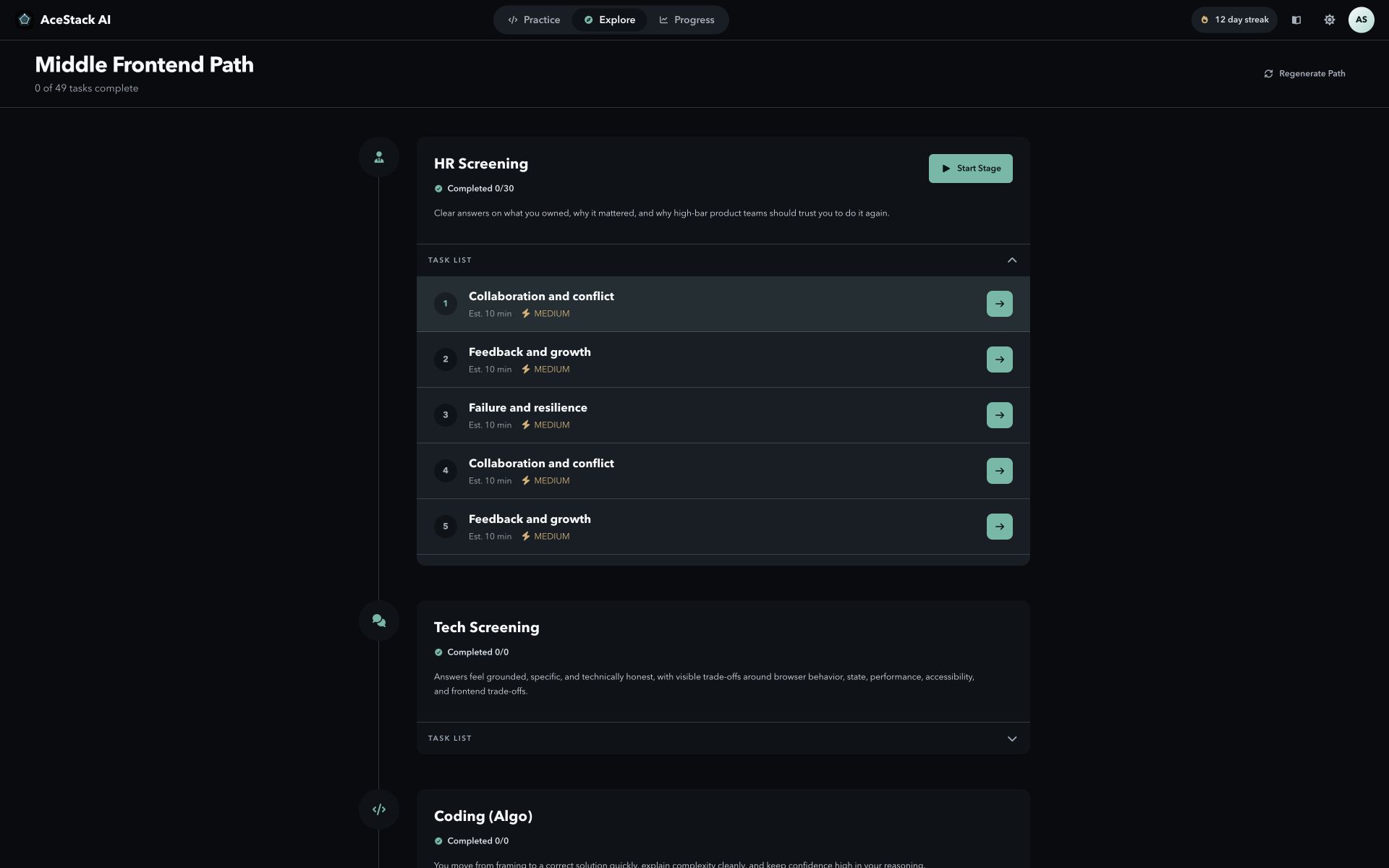
Start with the interview loop, not a list of topics
A frontend candidate, a machine-learning engineer, and an SRE can all be asked about trade-offs, but they are not preparing for the same loop. Before choosing tasks, write down the rounds that are probable for your role and target environment: recruiter screen, technical screen, coding, SQL, system design, behavioral, debugging, or a specialist production case.
This changes what progress means. Solving another array problem cannot compensate for a system-design answer that never clarifies scale. Rehearsing leadership stories cannot compensate for code that has no tests. Each stage needs its own readiness signal.
Take a baseline before you start studying
Complete one representative task in every likely stage without hints. Preserve the transcript, code, diagram, or written decision. The baseline should feel slightly uncomfortable: its purpose is to expose the current process, not to produce a flattering score.
- Screening: can you answer directly, support claims, and stay within the timebox?
- Coding: can you derive the solution, implement it, test it, and explain complexity?
- System design: do you clarify constraints before drawing and cover failure paths?
- Behavioral: can you separate your actions from the team and quantify impact?
- Specialist cases: can you inspect evidence before committing to a diagnosis?
Do not reduce the result to one global percentage. Record the missing signals. “System design: no capacity estimate and no ownership boundaries” is actionable. “Interview readiness: 54%” is not.
Use a weekly loop that forces correction
- Choose one weak stage and one weak topic inside it.
- Study one strong worked example and extract the decision process.
- Complete two guided attempts with progressively fewer hints.
- Complete one timed attempt without intervention.
- Compare the artifacts, name the remaining gap, and select the next task from that evidence.
The important transition is from understanding an example to producing an answer independently. Watching another explanation feels productive because recognition is easy. Interview performance requires recall, sequencing, judgment, and communication under a time limit.
Difficulty and seniority are different axes
An easy question can still reveal seniority. A junior candidate may be expected to identify the core mechanism and implement a correct solution. A senior candidate answering the same prompt may also need to expose operational risks, alternative designs, ownership boundaries, and the conditions under which the initial choice stops working.
Select task difficulty based on the skill you are training. Evaluate the answer against the seniority you are targeting. Mixing those decisions produces either demoralizing tasks or generous scores that do not predict interview performance.
A realistic 30-day structure
- Days 1–3: map the loop and capture a baseline in every stage.
- Days 4–10: repair the two largest process gaps with guided practice.
- Days 11–20: alternate targeted tasks with timed attempts.
- Days 21–26: run full-loop rehearsals and revisit repeated failure patterns.
- Days 27–30: reduce volume, rehearse communication, and preserve sleep and recovery.
The plan should change after evaluated attempts. If a candidate repeatedly produces correct code but misses edge cases during explanation, the next task should train test design and verbal reasoning, not simply increase algorithmic difficulty.
Measure evidence, not activity
Hours studied, videos watched, and questions opened are activity metrics. Useful preparation metrics describe behavior: first-pass correctness, unprompted requirement coverage, time to a defensible decision, repeated rubric gaps, and performance across different tasks in the same stage.