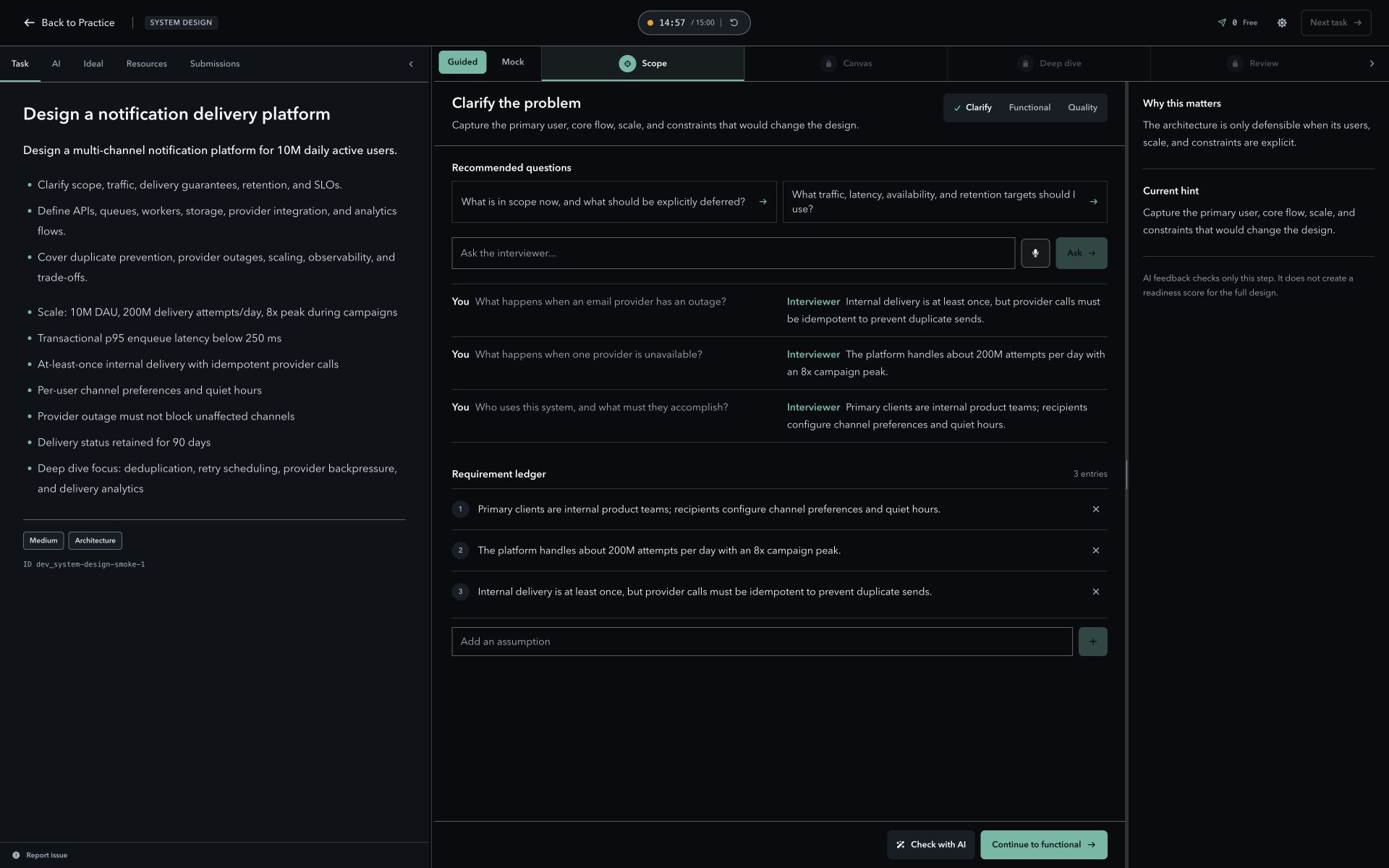
The diagram is not the whole answer
A polished diagram can still hide weak reasoning. If the candidate has not clarified users, scale, latency, durability, and failure tolerance, the boxes have no design pressure behind them. If data ownership and critical flows are not visible, the diagram is decoration rather than an engineering artifact.
A strong session produces several linked outputs: clarified requirements, rough capacity assumptions, an end-to-end flow, a data model, explicit trade-offs, and a focused deep dive. The diagram should make those decisions easier to inspect.
A repeatable sequence for the interview
- Restate the goal and ask the questions that can materially change the architecture.
- Separate functional requirements from quality constraints.
- Estimate only the numbers that influence storage, throughput, partitioning, or cost.
- Define the core API and data ownership before adding infrastructure.
- Draw one critical flow end to end.
- Identify bottlenecks and failure paths, then choose one deep dive.
- Close by summarizing trade-offs, unresolved risks, and what you would validate next.
Clarifying questions must change a decision
“How many users?” is only useful when the answer changes the design. Ask about peak traffic rather than a vague total. Ask whether duplicate delivery is acceptable, whether ordering matters, which operations require strong consistency, and what can degrade during an outage.
- Who performs the primary action and what outcome must they receive?
- What is the peak request or event rate?
- Which latency and availability targets are contractual?
- What data must survive a regional failure?
- What is explicitly out of scope for this session?
Good questions reduce the solution space. A long list of generic questions consumes time without demonstrating judgment.
What the architecture diagram should prove
- The main request or event flow can be followed without narration.
- Stateful components and their ownership are explicit.
- Synchronous and asynchronous boundaries are distinguishable.
- Data stores have a reason to exist and a clear access pattern.
- Retries, idempotency, backpressure, and degraded behavior appear where relevant.
- The deepest risk in the design is visible enough to discuss.
The evaluator should inspect the diagram and the explanation together. Text may claim that retries are safe while the diagram shows no idempotency boundary. That contradiction is valuable assessment evidence.
How seniority changes the evaluation
Junior candidates benefit from a clear decomposition and correct core flow. Middle-level candidates should connect requirements to components, discuss failure handling, and make credible data choices. Senior candidates are expected to shape scope, expose organizational and operational trade-offs, prioritize uncertainty, and know where additional complexity is not justified.
The same prompt can be appropriate across levels when the rubric changes. What must remain stable is the evidence standard inside each level: two candidates producing equivalent decisions should receive equivalent evaluation.
| Target level | Evidence expected in the same prompt |
|---|---|
| Junior | Correct core flow, clear decomposition, and a basic explanation of component responsibilities. |
| Middle | Requirements connected to components, credible data choices, and explicit failure handling. |
| Senior | Scope leadership, prioritized uncertainty, operational trade-offs, and justified restraint. |
How to practice without memorizing diagrams
- Complete the requirements phase before opening the reference architecture.
- Draw the critical flow from memory and narrate why each boundary exists.
- Ask for feedback on the weakest phase, not a generic overall score.
- Redraw only the failed part and explain what changed.
- Repeat with a different domain that creates the same design pressure.
The goal is not to remember a notification system or a feed. It is to recognize pressure such as fan-out, ordering, hot partitions, delivery guarantees, or multi-region ownership and then choose a defensible response.
A useful review is phase-specific
A single final score hides where the process failed. Review requirements, estimates, API and data model, architecture, deep dive, and communication separately. Then connect the weaknesses: an omitted availability target may explain a missing failover path later in the diagram.